
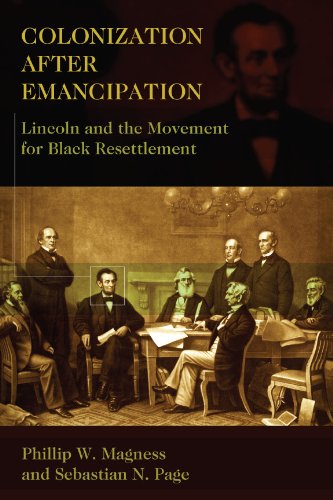
Colonization After Emancipation: Lincoln and the Movement for Black Resettlement
Product details
| Management number | 232089421 | Release Date | 2026/06/18 | List Price | US$9.66 | Model Number | 232089421 | ||
|---|---|---|---|---|---|---|---|---|---|
| Category | |||||||||
History has long acknowledged that President Abraham Lincoln, the Great Emancipator, had considered other approaches to rectifying the problem of slavery during his administration. Prior to Emancipation, Lincoln was a proponent of colonization: the idea of sending African American slaves to another land to live as free people. Lincoln supported resettlement schemes in Panama and Haiti early in his presidency and openly advocated the idea through the fall of 1862. But the bigoted, flawed concept of colonization never became a permanent fixture of U.S. policy, and by the time Lincoln had signed the Emancipation Proclamation on January 1, 1863, the word “colonization” had disappeared from his public lexicon. As such, history remembers Lincoln as having abandoned his support of colonization when he signed the proclamation. Documents exist, however, that tell another story. Colonization after Emancipation: Lincoln and the Movement for Black Resettlement explores the previously unknown truth about Lincoln’s attitude toward colonization. Scholars Phillip W. Magness and Sebastian N. Page combed through extensive archival materials, finding evidence, particularly within British Colonial and Foreign Office documents, which exposes what history has neglected to reveal—that Lincoln continued to pursue colonization for close to a year after emancipation. Their research even shows that Lincoln may have been attempting to revive this policy at the time of his assassination. Using long-forgotten records scattered across three continents—many of them untouched since the Civil War—the authors show that Lincoln continued his search for a freedmen’s colony much longer than previously thought. Colonization after Emancipation reveals Lincoln’s highly secretive negotiations with the British government to find suitable lands for colonization in the West Indies and depicts how the U.S. government worked with British agents and leaders in the free black community to recruit emigrants for the proposed colonies. The book shows that the scheme was never very popular within Lincoln’s administration and even became a subject of subversion when the president’s subordinates began battling for control over a lucrative “colonization fund” established by Congress. Colonization after Emancipation reveals an unexplored chapter of the emancipation story. A valuable contribution to Lincoln studies and Civil War history, this book unearths the facts about an ill-fated project and illuminates just how complex, and even convoluted, Abraham Lincoln’s ideas about the end of slavery really were. Read more
| ASIN | B004WPNWCW |
|---|---|
| XRay | Not Enabled |
| ISBN13 | 978-0826272355 |
| Edition | First |
| Language | English |
| File size | 1.0 MB |
| Page Flip | Enabled |
| Publisher | University of Missouri |
| Word Wise | Enabled |
| Reading age | 18 years and up |
| Print length | 178 pages |
| Accessibility | Learn more |
| Screen Reader | Supported |
| Publication date | March 28, 2011 |
| Enhanced typesetting | Enabled |
Bestseller ranking
Alternative Medicine

Customers who viewed this product also viewed
Abolition


Correction of product information
If you notice any omissions or errors in the product information on this page, please use the correction request form below.
Correction Request Form